 Vacation Tours of Ireland
Driving in Ireland: What a Visitor Needs to Know
Driving in Ireland means driving on the left, in kilometres in the Republic and in miles in Northern Ireland, with a licence from home and an insurance excess you should understand before you book. This guide covers the rules that apply across the island, the documents to carry, speed limits, tolls, drink-drive limits and the hire-car details that catch visitors out: age rules, excess amounts and border fees. It also explains when a guided tour is the simpler answer. The bookable tours are compared on all vacation tours of Ireland.
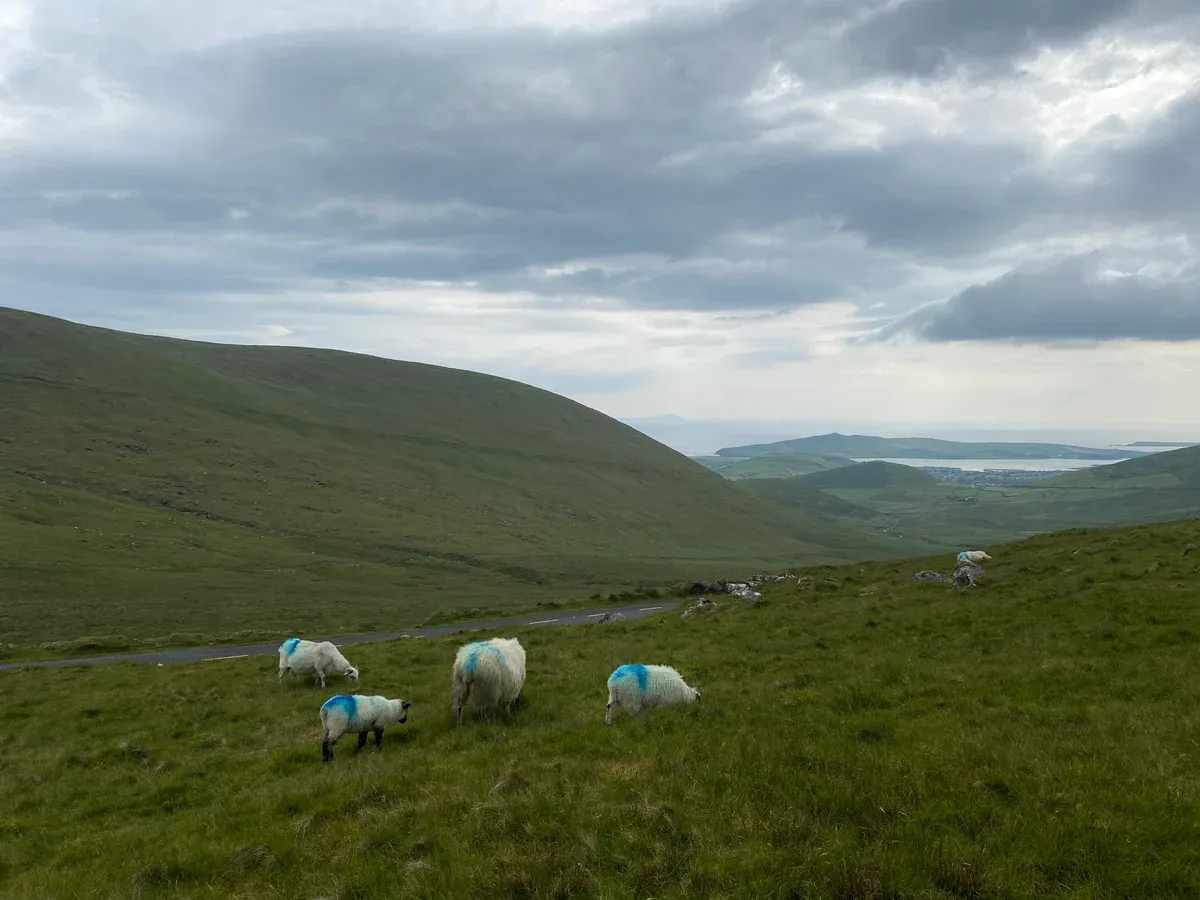
Sheep grazing beside the road on the Conor Pass. Photo: 瑞丽江的河水, CC BY-SA 4.0, via Wikimedia Commons
Quick answer The short version
Driving in Ireland is on the left, and a visitor can drive on a full national licence, though hire desks want the licence issued in your country of residence. The catch is money: basic damage excess at Irish desks runs about €1,800 to €3,500, held as a pre-authorisation on your card.
Key takeaways
- Speed limits switch units at the border: km/h in the Republic, mph in Northern Ireland. See the rules table.
- The M50 in Dublin is barrier-free at €3.80 unregistered for a car, and you must pay before 8pm the next day. Tolls are covered in the rules section.
- Taking a hire car into Northern Ireland usually costs a cross-border fee, €40 at Hertz and €34 at Budget. Details under hiring the car.
- If the excess, narrow roads and left-side driving sound like work, a guided trip such as the 4-Day South West Ireland Tour at $568.20 removes all of it.
The Rules at a Glance
One island, two countries and two sets of road rules. The border is open, so you can cross without noticing, which is exactly why the differences matter.
Republic and Northern Ireland Side by Side
The table below lines up the rules that change when you cross the border. Speed limit figures come from Tourism Ireland, drink-drive limits from the Garda and NIDirect, and toll information from Tourism Ireland and Transport Infrastructure Ireland. Hertz warns that there are few border identifiers, so watch for the switch from kilometres to miles on the signs.
| Rule | Republic | Northern Ireland |
|---|---|---|
| Side of the road | Left | Left |
| Speed limit units | km/h | mph |
| Built-up / urban limit | 30 km/h | 30 mph |
| Open single road | 60 km/h (non-national), 80 km/h (national) | 60 mph (single carriageway) |
| Motorway limit | 120 km/h | 70 mph |
| Drink-drive limit (blood) | 50 mg per 100 ml, 20 mg for learner, novice and professional drivers | 80 mg per 100 ml (35 micrograms per 100 ml of breath) |
| Tolls | Yes, on a number of roads including the M50 at €3.80 unregistered for a car | None |
| Seat belts | Front and back, everyone | Worn by everyone |
| Phone at the wheel | €120 fixed charge and 3 penalty points | not stated |
Licences and Documents
Visitors need a valid full national driving licence, or an international driving permit, and in the Republic you must carry your licence at all times. You also need car insurance in your own name or as a named driver. In practice the hire firms decide: the Department of Transport says most car rental companies want a licence issued by the country you normally live in, not an international driving permit, and Budget's Republic terms ask for a physical copy of a full unendorsed licence held at least two years.
Carry the documents the Department lists: your licence, the vehicle registration certificate or rental agreement, valid insurance documentation and a certificate of roadworthiness. Drivers with foreign licences fall under Ireland's penalty points system. Points stay on a licence for 3 years, 12 points in 3 years brings a 6 month ban, and a speeding offence in the Republic carries a fixed charge of €160 plus 3 points.
If you are deciding between self-drive and a coach, the comparison of bookable multi-day trips sits on the homepage at the comparison table. For a first visit of about a week, see the 7 day Ireland itinerary.
Hiring the Car
The rental desk is where most of the money and most of the confusion sit. Here are the age rules, the excess figures and the border fee before you book.
Age and Licence Rules at the Desk
Budget in the Republic requires a physical copy of a full unendorsed licence held at least two years, issued in the driver's country of residence, and drivers disqualified in the last 10 years cannot rent. Licence age also depends on the car group: 8 years for most groups including full-size SUVs and estates, 10 years for people carriers and 12 years for luxury cars and minibuses.
Hertz in Ireland needs a full valid national licence, with eligibility from 6 years for small cars to 12 years for other groups, always including at least 2 years of full licence status. In Northern Ireland Hertz sets a minimum rental age of 25 for all groups, and 30 for larger models such as the Mercedes C Class and Land Rover Discovery. Child seats are mandatory by law in Ireland, and Hertz advises pre-booking them online.
Insurance Excess and CDW
Irish hire quotes usually include basic collision cover with an excess of about €1,800 to €3,500 on CARHIRE.ie, held as a pre-authorisation on your card. My Irish Cousin puts the range at €1,500 to €3,000 at Irish desks. Premium Protection on CARHIRE.ie cuts the excess to €300, and the pre-authorisation can take 21 days or more to clear after you return the car. Budget's damage excess is €2,000 to €4,500 depending on car group, with windscreen cover and Roadside Assistance Plus at €6 a day each. Super CDW at My Irish Cousin runs €20 to €35 a day.
That hold is real money blocked on your card for weeks after the trip. It is one of the reasons a guided coach removes friction: no hire car, no left-hand driving, no excess hold.
Credit-Card Cover and Why Desks Refuse a Letter
Many cards advertise rental insurance, and many Irish desks will not accept it. Rental desks do not accept a credit card letter of coverage as proof. The reason is practical: credit card rental insurance may not protect you in Ireland as primary cover, some policies exclude Irish rental companies outright, and the renter pays for damage upfront before claiming back from the card issuer.
So budget for one of three things: buy the desk's excess reduction, take a standalone car hire excess policy, or accept a four-figure hold on your card. Whichever you choose, the decision costs nothing to make at home and a lot to make at the counter.
Crossing Into Northern Ireland
The border is invisible in practice. The Common Travel Area keeps controls minimal, but your rental contract is not invisible to it. Hertz charges a cross border fee of €40 for taking a car into Northern Ireland, plus a drop-off fee if you return it to a Hertz location there. Budget charges €34, which covers vehicle retrieval after a breakdown, and Budget cars may not leave the island of Ireland.
Visitors who need a UK ETA must hold one to visit Northern Ireland, arriving directly or via the Republic, and each family member including children needs their own. Decisions usually arrive within one day and can take up to three working days. Also tell your phone carrier before you go: roaming between the Republic and Northern Ireland depends on your plan, so check with your carrier before you go.
If you would rather see the north without the paperwork, the 2-Day Northern Ireland Tour from Dublin at $226.59 includes Belfast, the Giant's Causeway and both visitor centre entries, or the 5-Day Northern Ireland Tour adds Donegal, Mayo and Connemara.
On the Road
Tolls, narrow roads, roundabouts, parking and fuel are the things that catch visitors out once the car is moving. Here is what to expect.
The M50 Barrier-Free Toll
The M50 ring around Dublin has no toll booths. Cameras read your plate and you pay afterwards. For a car the charge is €3.80 unregistered, €3.20 with a video account and €2.60 with a tag, according to Transport Infrastructure Ireland. Unregistered drivers must pay before 8pm the day after using the road, online at eflow.ie or at a Payzone shop. Miss that window and an initial default toll of the fare plus €4 applies, rising by a further €51 if it is still unpaid.
Many large rental firms pay the M50 on your behalf and bill you. Budget says its Republic of Ireland cars are registered for automatic eFlow payment and renters pay other tolls at the booth. Ask at the desk which system applies to your car, because an unpaid M50 charge can follow you home as a fine plus a €30 administration fee under Budget's terms.
The Other Tolls
There are no tolled roads in Northern Ireland, but a number of roads in the Republic charge. Most can be paid at the booth, and disabled drivers are not charged. The car rates below are the 2026 figures from Transport Infrastructure Ireland, so you can see what a driving route costs before you set out.
They matter most if you drive Dublin to Galway or Dublin to Cork, because both routes pass a toll plaza.
| Toll point | Route | Car rate |
|---|---|---|
| M50 barrier-free | Dublin ring | €3.80 unregistered |
| M1, Julianstown to Drogheda North | Dublin to Belfast | €2.30 |
| M3, Clonee to Kells | Northwest from Dublin | €1.80 |
| M4, Kilcock to Kinnegad | Dublin to Galway | €3.60 |
| M6, Ballinasloe West to Loughrea | Dublin to Galway | €2.30 |
| M7, Portlaoise West plaza | Dublin to Limerick and Cork | €2.30 |
| M8, Fermoy North to Watergrasshill | Dublin to Cork | €2.30 |
| Limerick Tunnel | Limerick | €2.30 |
| N25 Waterford bypass | Waterford | €2.30 |
R and L Roads
Motorways carry an M prefix, national roads an N prefix, and everything else is regional or local. The R and L roads are where Ireland earns its reputation. They are narrow and winding. The Dingle Peninsula association describes its peninsula roads as narrow and hilly. The Ring of Kerry loop is about 179 km. A guided Ring of Kerry tour from Killarney leaves the driving to someone else.
Another trap is the signs. The Republic shows distances in kilometres and Northern Ireland in miles, and Hertz warns there are few border identifiers, so you can cross without noticing and see the numbers change. In Gaeltacht areas of Donegal, Galway, Mayo, Kerry, Cork, Waterford and Meath, signs are in Irish only, so place names may differ from your map.
Roundabouts
Roundabouts appear everywhere, including at small rural junctions. The RSA Rules of the Road say to treat one as a junction and yield to traffic coming from your right, keeping moving if the way is clear. Use the left lane for exits before 12 o'clock on the clock face and the right lane for exits after it, unless road markings say otherwise.
Do not signal left until you have passed the exit before the one you want, except when taking the first exit. In practice, go slowly on your first few and let the traffic flow teach you.
Parking
Parking is set by each local authority, so the system changes from town to town. Three setups are common. Pay and display machines, mobile apps, and disc parking, where you buy a paper disc from a newsagent or shop and display it on the windscreen. Some cities and smaller towns use the disc system.
Apps worth downloading before you go are Payzone, ParkMagic and Easytrip for the Republic, and RingGo and JustPark for Northern Ireland, according to Tourism Ireland. If you hold a disabled parking permit, EU permits, UK Blue Badges and Australian and New Zealand permits are all accepted on the island. Parking in a dangerous place carries 3 penalty points and an €80 fixed charge, rising to €120 after 28 days.
Fuel
Fuel is straightforward. Prices are shown in euros in the Republic and pounds in Northern Ireland, so the number on the sign changes meaning at the border. Almost all stations take cards, and the usual routine is to fill up first and pay inside afterwards.
If you cross into Northern Ireland, remember your speedometer reading in mph and that fuel is priced in pounds.
Sources: Transport Infrastructure Ireland, eFlow, Tourism Ireland
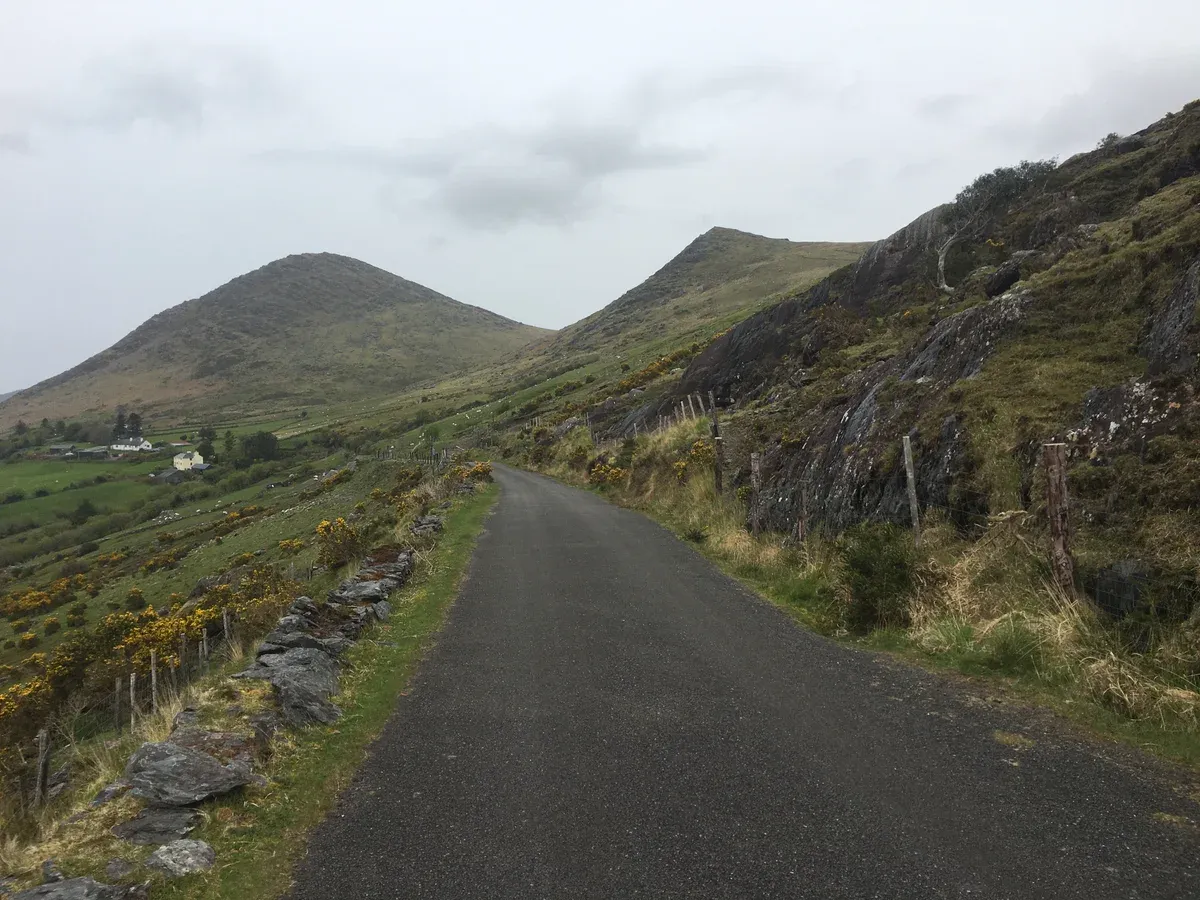
The narrow tarmac of the Healy Pass climbing between two hills. Photo: Steven Brown, CC BY-SA 2.0, via Wikimedia Commons
When a Guided Tour Is Simpler
Self-driving gives you freedom, but it also hands you the excess, the tolls and the narrow roads. A guided tour hands them back.
The Real Cost of Driving Yourself
Add it up before you decide. Irish hire desks hold a damage excess of roughly €1,500 to €3,000 as a pre-authorisation on your card, and Budget's excess runs €2,000 to €4,500 depending on car group. Cutting that to €300 with Premium Protection on CARHIRE.ie costs extra, as does windscreen cover or roadside help at €6 a day each with Budget. Add tolls, fuel, parking and the cross-border fee for Northern Ireland of €34 with Budget or €40 with Hertz, and the hire car is rarely the cheap option it first looks.
A guided coach removes the lot: no left-hand driving, no rural R roads and no excess hold. The trade-off is a fixed route. The full guided-versus-hire-car comparison sits on the vacation tours of Ireland homepage, and the bookable multi-day tours are laid out side by side in the tour comparison table.
Three Tours That Replace the Wheel
These multi-day tours cover the same ground a self-driver would, with accommodation and breakfast in the price. The 4-Day South West Ireland Tour costs $568.20 in a hostel dorm and from $854.01 with a private B&B room, and runs Dublin to Galway, the Cliffs of Moher, Killarney and Dingle with a Blarney Stone stop. The 5-Day South West Ireland Tour costs from $1,464.67, runs as a small group, and includes Cliffs of Moher admission and four nights with breakfast. The 6-Day All Ireland Tour costs from $1,023.66 in a dorm and from $1,706.86 with a private room, and covers Northern Ireland, Donegal, Galway, Clare, Kerry and Cork in six days.
Meals beyond breakfast are not included on any of the three, and admissions beyond those named above are not included, so read the cards before comparing them to your fuel budget.
Frequently Asked Questions
Do I have to pay the M50 toll in a rental car?
Usually no. Budget says its Republic of Ireland rentals are registered for automatic eFlow payment and many large firms pay on your behalf, but ask at the desk because unregistered drivers must pay the €3.80 car charge before 8pm the next day or face default fees. The details are in the M50 toll section above.
Can I take a hire car from the Republic into Northern Ireland?
Yes, for a fee. Budget charges a €34 cross-border fee and Hertz charges €40. Note there are no tolled roads in Northern Ireland and speed signs switch to miles, as covered in the R and L roads section.
What is the speed limit on Irish roads?
In the Republic the signs show km/h: 30 in built-up areas, 60 on single non-national open roads, 80 on national roads and 120 on motorways. In Northern Ireland they show mph: 30 urban, 60 single carriageway, 70 dual carriageway and motorway. The full rules sit in part one of this guide.
How bad are the narrow rural roads, really?
R and L roads are narrow and winding, and the Dingle Peninsula association calls its roads narrow and hilly. If that sounds tiring, a small-group tour such as the 4-Day South West Ireland Tour puts someone else at the wheel for $568.20 upwards.
Is it cheaper to drive in Ireland or take a guided tour?
Driving carries the excess hold of roughly €1,500 to €3,000 at the desk, tolls, fuel and parking on top of the hire fee, while a six-day guided circuit such as the 6-Day All Ireland Tour starts at $1,023.66 with five nights of accommodation and breakfast. See the guided tour section for the full cost picture.
Where can I park in Irish towns?
Towns use pay and display machines, mobile apps or disc parking, where you buy a disc from a newsagent and display it on the windscreen. Payzone, ParkMagic and Easytrip cover the Republic and RingGo and JustPark cover Northern Ireland, per Tourism Ireland. Parking fines and clamping add up, so budget for it in your Ireland trip cost.