 Vacation Tours of Ireland
Where to Stay in Ireland
Choosing where to stay in Ireland matters more than choosing which sights to see, because most towns work only as a base for a small area. This guide compares the six most useful bases for a first trip, explains which traveller each one suits, and sets out the transport links that decide how easy a base is to reach without a car. It also covers the choice between a hotel, a guesthouse and a home B&B, and how the Fáilte Ireland approval system sorts them. If you would rather hand over the driving and the room booking together, the guided vacation tours of Ireland on the homepage include their accommodation in the price. Pick a base from the table below, then read the area detail.
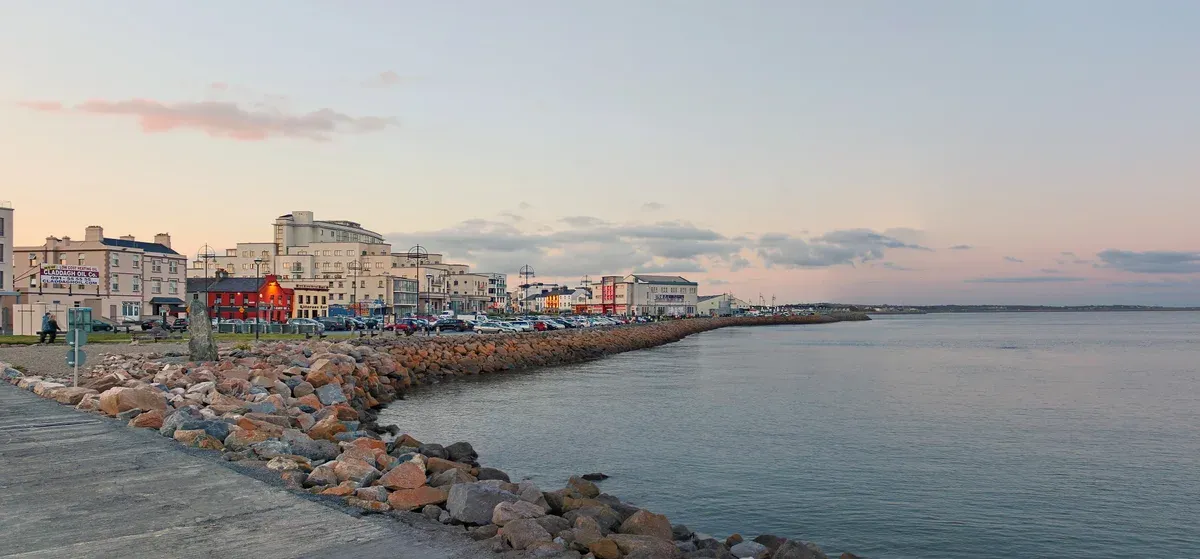
The Salthill seafront and Galway Bay at dusk. Photo: Robert Linsdell from St. Andrews, Canada, CC BY 2.0, via Wikimedia Commons
Quick answer The short answer
For a first trip, the best bases are Dublin, Galway, Killarney and Belfast, with Dingle and Westport as second choices. Dublin is 7 km from the main airport and Galway sits roughly 2 to 2.5 hours west of Dublin by road, so both are easy first and second stops. Killarney has its own train station with services from Dublin and Cork, and Belfast is under 2 hours from Dublin by car and about 2h 05m to 2h 20m on the Enterprise train.
Key takeaways
- See the full base-by-base comparison in The Bases Compared below.
- If you plan to hire a car between bases, the rules and costs are in the guide to driving in Ireland.
- The bookable multi-day tours on the homepage pair each route with its own accommodation.
- For a day-by-day plan that strings these bases together, see the 7 day Ireland itinerary.
The Bases Compared
Each Irish base earns its place for a different reason. The table compares the six towns this guide covers, who each suits, and how you reach and leave them without a car.
Base by Base at a Glance
The figures and links below come from Ireland's official transport and tourism pages, plus the Dingle Peninsula tourism association. Use the table to narrow down to two bases, then read the area sections for street-level detail. Dublin and Galway are covered together further down this page, Killarney, Dingle, Westport and Belfast follow in part two of this guide.
If you would rather let an operator choose the rooms, the Dublin to South West 5 Day Small-Group Tour with Accommodation sleeps one night in Galway and three in Killarney from $1,464.67 with breakfast included.
| Base | Suits | Getting around |
|---|---|---|
| Dublin | First-time visitors, city breaks, anyone flying in | Airport 7 km north of the centre, Dublin Bus 16 and 41 cost €€€2 to €3.30 and take 30 to 50 minutes, route 41 runs around the clock |
| Galway | West coast fans, walkers, music and pub culture | Roughly 210 km from Dublin, 2 to 2.5 hours by car on the M4 and M6, about 2h 30m by bus |
| Killarney | National park walkers, Ring of Kerry day tours | Train station with services from Cork and Dublin, Bus Eireann coaches and the Flight Link coach from Dublin Airport |
| Dingle | Slow travellers who want one place for a week | 55 km from Kerry Airport, 352 km from Dublin Airport, peninsula roads are narrow and hilly |
| Westport | Connemara and Mayo trips | A night stop on the 5-day Rabbie's Atlantic coast route |
| Belfast | Giant's Causeway, Titanic Belfast and Northern Ireland | About 168 km from Dublin, 1h 45m by car, about 2h 13m by train, hourly Enterprise service |
How Many Bases Do You Need
Two bases cover most first trips of a week or less. A Dublin and Galway pair reaches the east and the west, and the road between them is the M4 and M6, Ireland's first city-to-city motorway when it opened in December 2009. Three bases let you add Killarney or Belfast.
The 6-Day All Ireland Tour shows the logic at work: five nights split across Belfast, Derry, Galway, the Dingle Peninsula and Killarney from $1,023.66 in a shared dorm, so a guided route is really a moving base. The coastal route is covered in the guide to the Wild Atlantic Way.
Sources: Ireland.com, Met Éireann
Room Lists by Base
Each link opens the live room list for that base. Dublin is where every multi-day tour starts, Galway and Killarney are the two western hubs, and Dingle is the overnight on most South West loops.
Dublin city centre
- Suits
- The night before and after a tour, since every multi-day tour starts in Dublin
The airport is 7 km north of the centre, with buses running around the clock on route 41.
See stays in Dublin city centreGalway
- Suits
- Day tours to the Aran Islands, the Cliffs of Moher and Connemara
Trains from Dublin Heuston take about 2h 20m to 2h 50m.
See stays in GalwayKillarney
- Suits
- The Ring of Kerry, the national park and the Gap of Dunloe
Trains from Dublin take about 3h 21m with a change at Mallow.
See stays in KillarneyDingle
- Suits
- The Slea Head Drive and the Blasket Islands
Dingle town is about 71 km from Killarney by road.
See stays in DingleDublin and Galway
These are the two most common bases for a first trip, and the ones searchers ask about most. Here is where to sleep in each and why.
Where to Stay in Dublin
For a first visit, stay within walking distance of the city centre so you can reach departure points on foot. Temple Bar is the cobbled district on the south bank of the Liffey that has drawn visitors since the mid-1990s for pubs and live music, and it also holds museums and independent shops. St Stephen's Green is a 22 acre public park created in 1664, next to Grafton Street and a Luas stop.
Ballsbridge is an inner suburb on the south side, north and west of a bridge over the River Dodder, and the US embassy is there. Smithfield on the Northside sits around a public square with the Old Jameson Distillery, an observation tower and the Cobblestone traditional music pub. Almost every guided day tour leaves from a central point rather than offering hotel pickup, so a central room saves real time.
The Cliffs of Moher, Burren and Galway day tour departs from outside Dublin City Gallery The Hugh Lane at $87, and the Giant's Causeway, Dark Hedges, Dunluce and Belfast tour uses the same meeting point at $89.
Getting From Dublin Airport to Your Room
The airport is 7 km north of the city centre, so your first night's base decides your arrival cost. Dublin Bus routes 16 and 41 cost €€€2 to €3.30 and take 30 to 50 minutes, and route 41 runs around the clock. Aircoach route 700 costs about €€€8 to €10 and takes 30 to 40 minutes.
Dublin Express runs from 4am to 12:30am for about €9. A taxi costs roughly €€€30 to €45 and takes 20 to 30 minutes.
Where to Stay in Galway
The Latin Quarter is the answer for most visitors asking where to stay in Galway. It extends from the Spanish Arch to O'Brien's Bridge, St Nicholas' Church and Middle Street, and holds many of the city's best-known shops, pubs, restaurants and hotels alongside medieval buildings. High Street within it is a short cobblestoned stretch of small independent shops.
Staying here puts you inside the evening atmosphere without a walk home. Eyre Square, officially the John F. Kennedy Memorial Park, is the practical choice instead: the tourist office on Forster Street sits near the train station at the lower end of the square, so the train station is close. Galway is where the Aran Islands and Cliffs of Moher tour and cruise departs from, a 10.5-hour day at $89 with check in by 8:40 to 8:45 AM and public paid parking on Merchants Road.
Salthill suits families and slower stays. Discover Ireland describes it as a seaside suburb with a 3 km promenade, a swimming spot at the Blackrock diving tower and a tradition of kicking the wall at the end of the prom.
Dublin or Galway as Your Main Base
Dublin wins on arrivals, day tours and onward trains. Dublin Heuston serves Cork, Killarney and Galway, and Irish Rail's journey planner covers those and Belfast and sells Leap cards. The Dublin to Cork line is 266.75 km long with 14 daily services Monday to Saturday, and Kerry trains run via Mallow through Killarney and Farranfore for Kerry Airport.
Galway wins on the west: Connemara, the Burren and the Aran Islands all sit within a day trip, which we detail in the guide to Connemara. Many travellers do both, and the road trip between them is covered in the guide to driving in Ireland. If you would rather not arrange rooms in each town yourself, a guided route bundles them.
The 4-Day South West Ireland Tour sleeps in Galway, Annascaul on the Dingle Peninsula and Killarney from $568.20 in a shared dorm or from $854.01 for a private room.
Killarney, Dingle, Westport and Belfast
Four bases that each anchor a different corner of the island, with the transport links and the kind of stay each suits.
Killarney
Killarney works as a base if the national park and the Ring of Kerry are the point of the trip. Killarney House and Gardens sit just south of Main Street, and the heart of Killarney National Park is 6 km south of town along Muckross Road, reached on foot, by bike or by jaunting car. The Knockreer Circular Walk is 5 km, graded easy, and starts and ends at Killarney House. The town has a train station with services from Cork and Dublin, Bus Eireann coaches, TFI Local Link Kerry and the Flight Link coach from Dublin Airport. Dublin to Killarney is about 301 km and 3h 17m by car, and the bus takes about 4h 25m. If you stay here without a car, the Ring of Kerry Tour from Killarney is a 7.5-hour guided loop for $55 that offers pickup on request.
Guided tours use Killarney as an overnight stop too. The 4-Day South West Ireland Tour from $568.20 beds its group in Killarney on the last night, after stops in Galway and on the Dingle Peninsula.
Dingle
Dingle town suits travellers who want one small town and the peninsula outside the door. It sits 55 km from Kerry Airport and 352 km from Dublin Airport, and the peninsula roads are narrow and hilly, which matters if you plan to drive them yourself. The page on the Dingle Peninsula covers the routes in detail. From the marina in Dingle, as well as from Dunquin and Ventry, ferries run to the Blasket Islands, and Dingle Boat Tours lists a 4 hour 30 minute boat tour.
Tours that overnight here include the 6-Day All Ireland Tour, which stops on the Dingle Peninsula with a night in a private room from $1,706.86, and the 10-Day Wild Ireland Tour from $3,301, which holds a two-night stay in Dingle so you unpack once.
Westport
Westport is the Mayo base for Connemara, Clew Bay and the north end of the Atlantic coast, and the Connemara guide covers the landscapes nearby. It is the overnight town on the northern leg of the 5-Day Northern Ireland and Atlantic Coast Small-Group Tour, which runs from $1,486.20 in a B&B or $1,639.68 in a 3-star hotel and gives 4 nights with breakfast split between Portrush, Donegal and Westport. The 10 Day Wild Irish Experience from $3,301 includes an award-winning Westport walking tour among its entry fees.
If you are building your own route, Westport sits well for the Wild Atlantic Way through Mayo, with Galway and Clare to the south.
Belfast
Belfast is the base for Northern Ireland, and prices there run in pounds, not euros. Dublin to Belfast is about 168 km and 1h 45m by car. The Enterprise train is hourly and takes 2h 05m to 2h 20m, ending at Belfast Grand Central, and the Aircoach bus takes about 2h 25m. Note that Northern Ireland speed limits are in mph, 30 in urban areas and 70 on motorways, and there are no tolled roads there.
Tours that sleep here include the 2-Day Northern Ireland Tour from $226.59, which gives 1 night in a B&B or hostel dorm and includes Titanic Experience and Giant's Causeway visitor centre entry. The 10-Day Ireland Tour from $3,917.02 puts a night in Derry and covers Antrim, Donegal and the south in one run. For currency, border and ETA questions, the cross-border section on the vacation tours of Ireland homepage covers it.
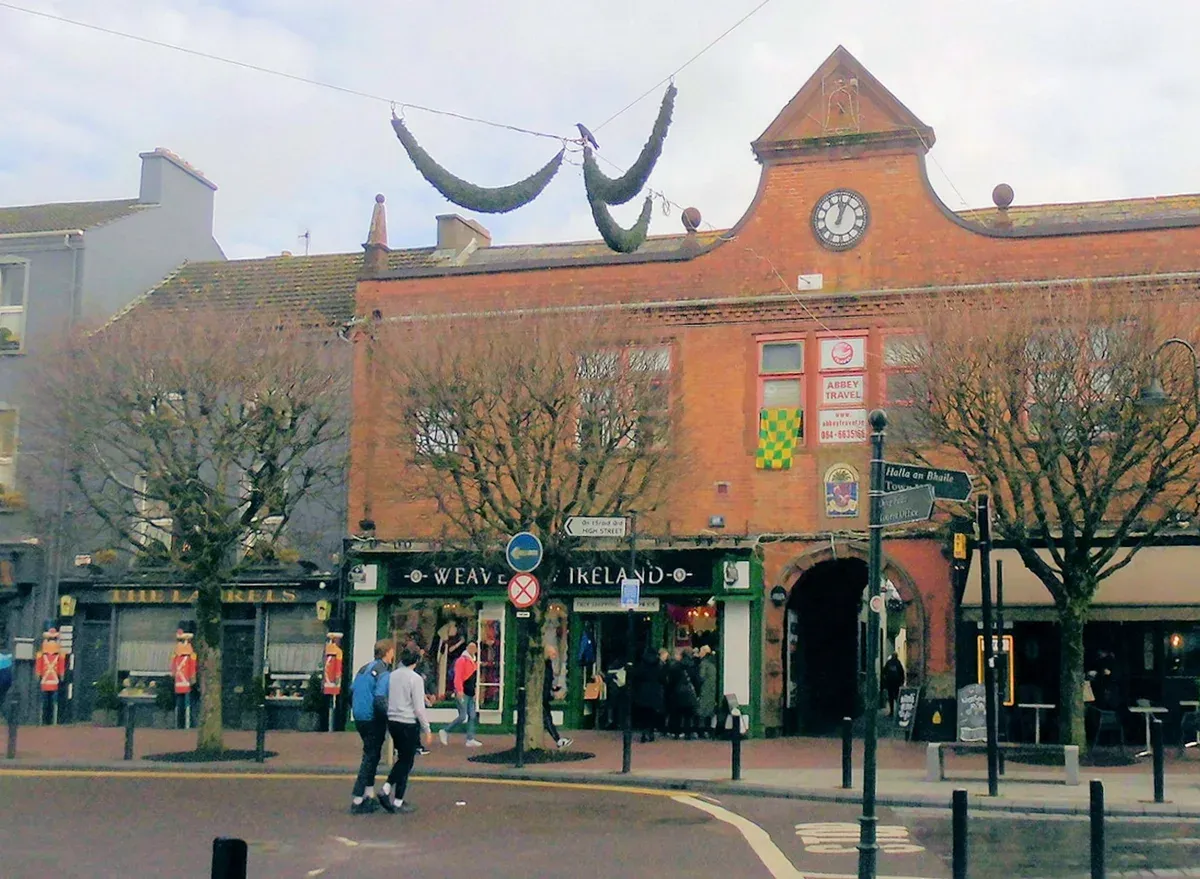
The former town hall at the top of Killarney's High Street. Photo: Rauenstein, CC BY-SA 3.0
B&B, Guesthouse or Hotel
What the three accommodation types legally mean in Ireland, how Fáilte Ireland approval works, and what the guided tours actually book.
The Fáilte Ireland Approval System
Under the Tourist Traffic Acts, any business calling itself a hotel, guesthouse, hostel, caravan and camping park, holiday camp or registered self-catering must register with Fáilte Ireland. That registration is the legal floor. On top of it, Fáilte Ireland classifies hotels from 2 star to 5 star, and each level has its own criteria. So a hotel star rating is a classification with its own criteria, not a marketing claim.
B&Bs and historic houses are different. They are non-statutory, so Fáilte Ireland approval is voluntary. An approved Irish home B&B is owner-occupied, with 2 to 6 guest bedrooms and no more than 9 bedrooms in the house including the family's own. A separate voluntary Welcome Standard approval marks stays judged friendly and hospitable under the National Quality Assurance Framework. When you compare rooms, look for the approval on a B&B and the registration on a guesthouse. A B&B without approval has simply not joined the voluntary scheme.
Guesthouse Versus B&B
The definitions are set by the registration rules. To register as a guesthouse, a business must have 7 to 30 guest bedrooms with private bathrooms and provide breakfast. A home B&B, as above, is owner-occupied with a maximum of 6 guest bedrooms. In practice that means a guesthouse is a small commercial property with more rooms, and a B&B is somebody's house with a few guest rooms and the owner living in.
Tours book both. The 3-Day Ireland Rail Tour from $1,183.73 includes 2 nights in B&B with a full Irish breakfast, and notes that en-suites may be inside or outside the room, which is worth checking if that detail matters to you. The 10-Day Ireland Tour uses local boutique hotels and guesthouses chosen by the operator, with one night in an Irish castle.
What the Tours Book, and What It Costs
Multi-day tours sell accommodation as a room tier, and the gap between the cheapest and dearest tier can be large. Several operators set the pattern. Rabbie's sells a 3-star B&B or 3-star hotel choice, while Paddywagon sells a hostel dorm bed or a private room.
The figures below come from the tour listings on this site's comparison table on the homepage, where every tour is lined up side by side.
| Tour | Cheapest room tier | Mid tier | Top tier |
|---|---|---|---|
| 5-Day South West Ireland Tour | B&B double or twin from $1,464.67 | Hotel double or twin from $1,661.83 | Hotel single from $2,125.88 |
| 5-Day Northern Ireland and Atlantic Coast Tour | B&B double or twin from $1,486.20 | Hotel double or twin from $1,639.68 | Hotel single from $2,157.54 |
| 6-Day All Ireland Tour | Hostel dorm bed from $1,023.66 | Private B&B or budget hotel room from $1,706.86 | Economy single from $2,001.77 |
| 4-Day South West Ireland Tour | Hostel dorm bed from $568.20 | Private B&B or budget hotel room from $854.01 | Economy single from $1,053.28 |
What the Room Price Covers
Breakfast is included on every multi-day tour night on this site, whether the room is a dorm bed or a hotel single. Lunch and dinner are not listed as included on any of them, so the meal budget sits outside the tour price. The page on the Ireland trip cost works through what food and extras add.
Solo travellers should also read the room tiers carefully. Rabbie's prices a B&B single from $1,929.96 on the 5-day south-west route against $1,464.67 for a double or twin, and Overland Ireland charges a solo supplement for a private en-suite room. If you are travelling alone and want to cut the cost, the dorm tiers on Paddywagon's tours are the cheapest beds in the whole comparison, and the page on Ireland tours for seniors notes which small-group formats suit travellers who would rather skip hostels.
Where to Stay in Ireland: Questions
Is it better to stay in a B&B or a hotel in Ireland?
A hotel gives you a classified star rating, since Fáilte Ireland classifies hotels from 2 star to 5 star. B&B approval is voluntary, so look for the Fáilte Ireland mark. On guided tours you can pick: the 5-Day South West Ireland Tour sells a B&B room from $1,464.67 or a 3-star hotel room from $1,661.83 for the same route.
How do I know an Irish B&B is approved?
An approved Irish home B&B is owner-occupied with 2 to 6 guest bedrooms and no more than 9 bedrooms in the house in total, and Fáilte Ireland approval is the mark to look for. Registration is compulsory for hotels, guesthouses and hostels, while B&B approval is voluntary, so ask whether a B&B holds it.
Do multi-day tours from Dublin include accommodation?
Yes, and the tier is your choice at booking. The 6-Day All Ireland Tour includes 5 nights with breakfast, from a hostel dorm bed at $1,023.66 to a private room in a B&B, apartment or budget hotel from $1,706.86. Breakfast is in the price on all tours here, other meals are not.
What is the best base in Ireland without a car?
Killarney is one of the strongest car-free bases. It has a train station with services from Cork and Dublin, Bus Eireann coaches and the Flight Link coach from Dublin Airport, and the heart of Killarney National Park is 6 km south of town along Muckross Road. From there the Ring of Kerry Tour from Killarney covers a 7.5-hour loop for $55.
Do I need pounds for a stay in Belfast?
Yes. Northern Ireland uses pounds sterling, not the euro, so a night in Belfast is paid in pounds. The 2-Day Northern Ireland Tour handles the overnight for you from $226.59 with B&B or hostel accommodation, and includes Titanic Experience and Giant's Causeway visitor centre entry.
What does a single room cost on a guided tour?
Expect a clear solo premium over the twin rate. On Rabbie's northern route a B&B single is from $1,895.49 against $1,486.20 for a double or twin, and on the south-west route the B&B single is from $1,929.96. The cheapest single room is $1,053.28 on the 4-Day South West Ireland Tour.